Overshoot Lattice Hero
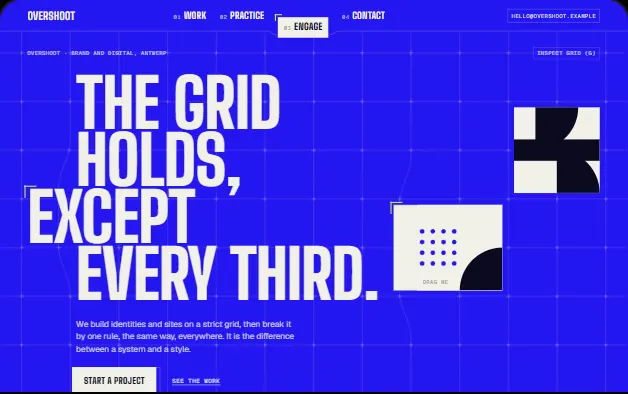
A first screen on a drawn lattice whose caps headline breaks it by rule, and a plate you drag to any free cell: drop it on column 3, 6 or 9 and it overshoots, wears the bracket, and the hairlines bend to make room.
Canvas 2D0 deps1 file · 41 KB TSXreduced-motion aware
Props
"use client";

import { useEffect, useRef, useState, useSyncExternalStore } from "react";
import type { CSSProperties, KeyboardEvent as ReactKeyboardEvent, MouseEvent as ReactMouseEvent, PointerEvent as ReactPointerEvent, ReactNode, RefObject } from "react";

/**
 * OvershootLatticeHero — a first screen on the drawn lattice, with the rule set in the headline and a plate you can move by it.
 *
 * The Klein-blue field carries the full lattice. The caps headline is a run
 * of lines, and its third (never the first or last) starts one column to
 * the left, the rule's overshoot at the scale of type. A construction plate
 * follows a drag 1:1 (or the arrow keys), shows the free cell it will take
 * (never over the words) and snaps there; on column 3, 6 or 9 it breaks by
 * the rule and the hairlines it crosses bend. G (or Inspect) shows the grid,
 * numbered, with each break read out; inspect={false} removes both. The
 * lattice is drawn on a canvas and sleeps when still.
 *
 * Part of the Broken Grid kit: a Klein-blue field #2416f0, paper plates

  // ---------------------------------------------------------------
  // Full source available with a viberdy Pro subscription.
  // https://viberdy.dev/pricing
  // ---------------------------------------------------------------
}
Details
About this heroe
The first screen of a studio that breaks the grid on purpose. A Klein-blue field carries the full lattice: hairlines through the gutter centres, square rows, small crosses where they meet. The caps headline is a run of lines from column 2, and the rule is computed on it like any run: the third line, never the first or the last, starts one column to the left with the acid bracket on its corner. Two construction plates sit on the lattice, one fixed and one you move. Drag it, or focus it and use the arrow keys: it follows 1:1, a dashed outline shows the free cell it will take (never over the words or the buttons), and it snaps there in 320ms. The columns are a run too, so on column 3, 6 or 9 it breaks, growing two gutters out while the hairlines it crosses bend. Press G, or Inspect, to see the grid numbered and each break read out; inspect={false} ships without both. On a phone the plates are hidden and the headline carries the rule.
Curator’s note
The Broken Grid kit's hero (slot 1, Featured), cut from broken-grid-site. Pro: a canvas lattice that measures the page's modules and bends its hairlines around the ones the rule breaks, a drag-and-snap plate bound to the same rule, and a grid inspector.